

Parking is one of the most common questions we get from Toronto buyers and homeowners, and one of the most misunderstood. Can you park in front of your own house? Does that parking pad come with the home you're buying? What does a street permit cost, and who gets to use a shared driveway? Toronto's rules are spread across several by-laws and City pages, so we've pulled the essentials into one place and updated every figure for 2026.
Updated November 2026. Fees change every year, so we've noted the source for each figure.
Quick answers
- How long can I park on a Toronto street? Without a permit, you're limited to three hours unless signs say otherwise.
- How much is a residential parking permit? $24.23 a month plus HST in 2026 for your first vehicle if you have no on-site parking.
- How much is a visitor permit? $20.74 for 24 hours, $29.97 for 48 hours or $44.94 for a week, plus HST.
- Can I build a front yard parking pad? Only in parts of the city where the by-law allows it, if your property qualifies and, usually, if your neighbours vote in favour.
- Does a parking pad licence transfer when I buy a home? No. The new owner has to apply to transfer it.
On-street permit parking
On City streets, vehicles without a permit are limited to three hours of parking unless signs post a different limit. Many residential streets, especially in older neighbourhoods without driveways, are designated for permit parking, typically overnight. On those streets, a permit lets you park during permit hours and exempts you from the posted time limits. A vehicle that stays in the same spot for more than seven days can still be ticketed and towed, even with a permit.
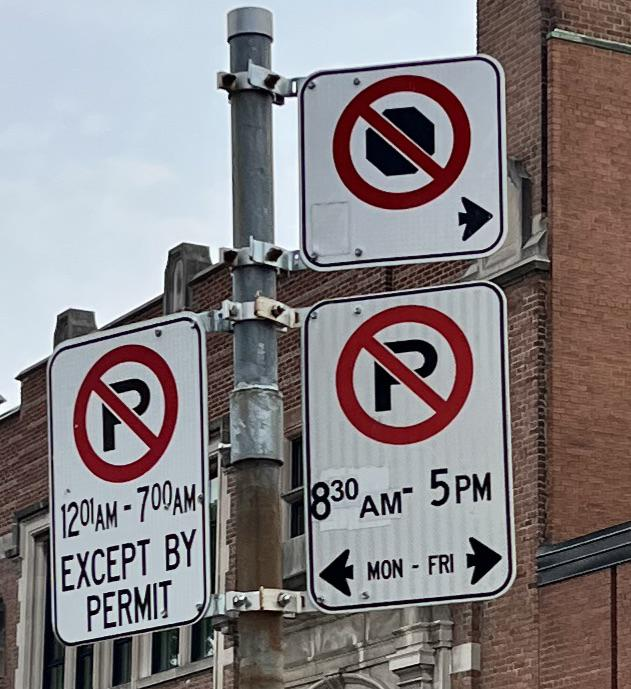
2026 residential permit fees
- No access to on-site parking, first vehicle: $24.23 per month plus HST
- No access to on-site parking, second and additional vehicles: $70.35 per month plus HST
- Access to on-site parking (permit for convenience): $97.97 per month plus HST
- Reissued permit: $10.40 plus HST
Permits run in six-month terms, from December 1 to May 31 and from June 1 to November 30, and you can buy two consecutive terms at once. To qualify, your street must be designated for permit parking and have space available (some areas have wait lists), and your vehicle registration and driver's licence must show your name and the permit address. To get the lower rate, you need to show that you don't have access to on-site parking.
Buyer tip: if the home you're considering has no driveway, check whether the street has permit parking and whether there's a wait list. It's an easy question to answer before you make an offer, and a frustrating one to discover after you close.
Temporary and visitor permits
Temporary permits let residents, guests and tradespeople park on a permit street when space is available. In 2026 they cost:
- 24 hours: $20.74 plus HST
- 48 hours: $29.97 plus HST
- 7 days: $44.94 plus HST
You can buy them online or at the Permit Parking office, up to two weeks in advance. The permit must be displayed on the lower driver's-side windshield.
Accessible parking permits
Accessible Parking Permits are issued by the Province through ServiceOntario, not the City, and they're free. There are five types:
- Permanent: for a permanent disability. Valid for five years and renewable without re-certification.
- Subject to change: for a condition that may change. Valid for five years, and a regulated healthcare practitioner must re-certify it to renew.
- Temporary: for a disability expected to last up to 12 months.
- Traveller: for permit holders travelling outside Ontario, so they can park at their point of departure, such as an airport. Valid for 12 months or the remaining life of the main permit, whichever is shorter.
- Company: for vehicles that companies or non-profits use to transport people with disabilities. Valid for five years.
Your application must be signed by a regulated healthcare practitioner. Accessible permit holders can also qualify for a wider front yard parking pad, as explained below.
Front yard and boulevard parking pads
Many older Toronto homes were built before cars, with no driveway. A front yard parking pad lets you park on your front yard or the City boulevard in front of your home, but only with a licence from the City. It is not something you can simply pave and start using.
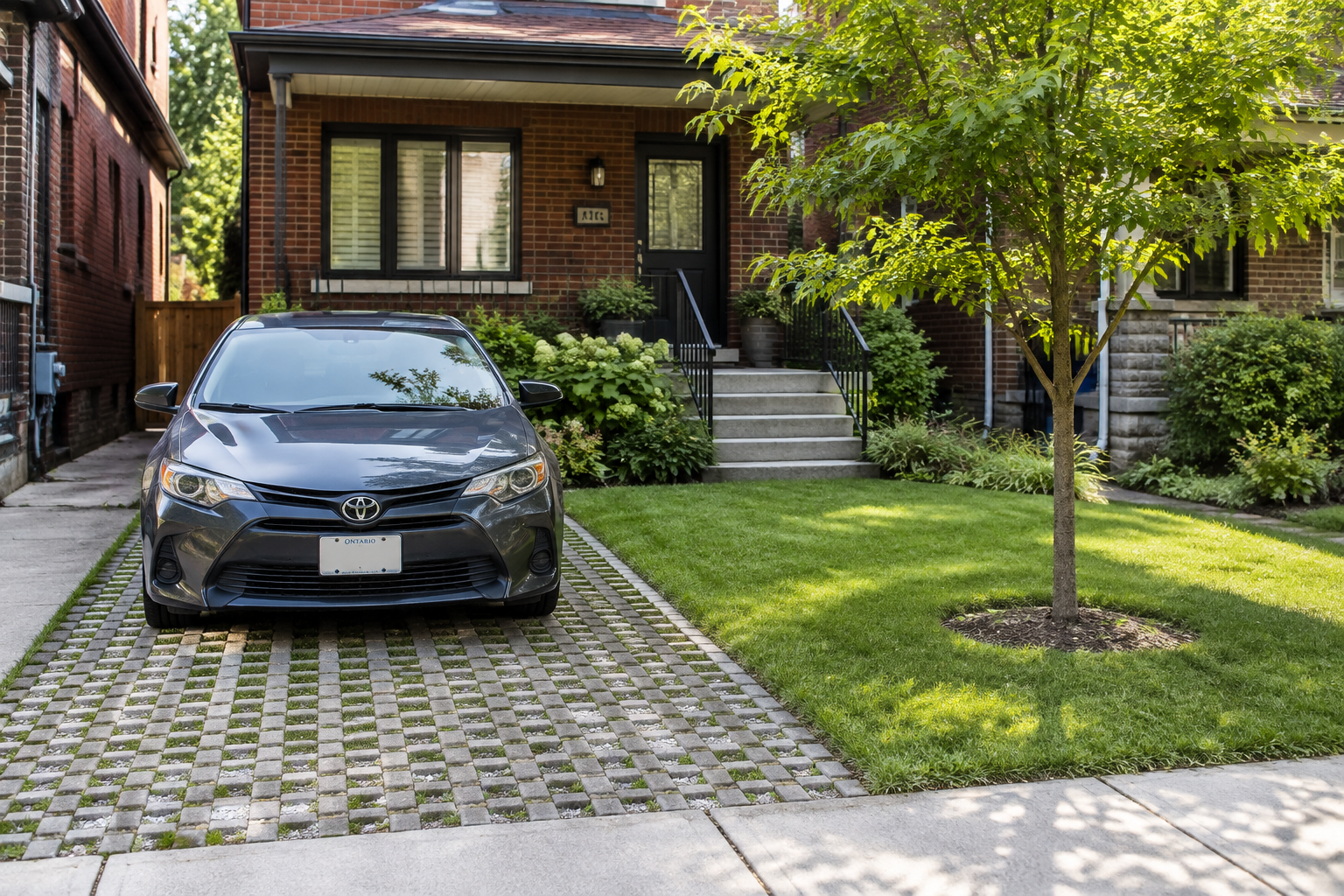
Where parking pads are allowed
Toronto's front yard parking rules are in Municipal Code Chapter 918. The City does not accept applications in large parts of Toronto, including most of the former suburbs and several neighbourhoods in the former City of Toronto. In some other areas, applications are only accepted for properties with an existing mutual driveway.
One thing that trips people up: the by-law refers to the wards set out in a 2002 provincial regulation, not the 25 wards used for today's City Council. That means you can't rely on your current ward number. Check your address with the City (call 311) or ask us before you count on a parking pad.
Who qualifies
Even where parking pads are allowed, the property must meet several conditions. The main ones:
- The property doesn't have a private driveway, and on-site parking isn't available or feasibly accessible.
- The home isn't on a major arterial road.
- Permit parking isn't authorized on the same side of the street, and nearby permit parking is at least 90% subscribed.
- Only one vehicle per property can be licensed.
- Neighbours support it. Most applications need a petition signed by at least half of the eligible properties, then a poll of the block. A favourable result needs at least 25% of eligible voters to respond and a majority of those voting to be in favour. A negative poll blocks new polls in that area for three years.
Size and design rules
- Width: 2.2 metres on narrower lots and up to 2.6 metres on lots 7.62 metres wide or more (up to 3.66 metres for accessible permit holders). Lots narrower than 5.5 metres, or 6.5 metres with a mutual driveway, don't qualify.
- Length: between 5.3 and 5.9 metres.
- Slope: a 2% to 6% grade rising from the sidewalk or curb toward the house.
- Paving: permeable paving is required.
- Clearances: the car must stay at least 0.3 metres from the sidewalk, doors, steps and windows, and the pad must be at least 2 metres from a fire hydrant.
- Trees: you can't remove a tree to make room for the pad, and you must agree to plant one. If you don't, the City plants it and adds the cost to your property tax bill.
Your front yard must also meet the zoning by-law's landscaping requirements. For many houses, that means at least half of a front yard on a lot 6 to 15 metres wide (60% on lots 15 metres or wider) must be landscaping, and most of that landscaping must be soft, such as grass and plants. Requirements vary by property, so confirm them with the City before you build.
2026 parking pad fees
- New application: $514.41 plus HST
- Annual licence renewal: $331.13 plus HST
- Transfer to a new owner: $165.56 plus HST, plus a $73.78 municipal charge added to the tax roll
- Appeal: $1,025.01 plus HST
- Inspection of an unlicensed pad: $896.62 plus HST
Unpaid fees can lead to the licence being cancelled and the amount being added to the property's tax bill.
Buying a home with a parking pad or driveway
Parking can add real value to a Toronto home, so it's worth confirming what you're actually buying.
- The licence doesn't automatically come with the house. The new owner has to apply to transfer it and pay the transfer fee. Accessible parking pad licences can't be transferred at all.
- Not every pad is legal. A paved front yard isn't proof of a licence. The City publishes a street index of licensed locations, and your lawyer can confirm it as part of the title search.
- Make it a condition. If parking matters to you, we'll write the offer so the seller confirms the pad is licensed and the fees are paid up.
- Driveway widening isn't automatic either. Widening a driveway or adding a second space has to comply with zoning. Check before you buy if your plans depend on it.
Shared (mutual) driveways
Mutual driveways are common between semi-detached and detached homes in older Toronto neighbourhoods. Each owner usually owns part of the driveway, and a right of way registered on title gives both owners the right to drive over the whole thing to reach parking at the back.
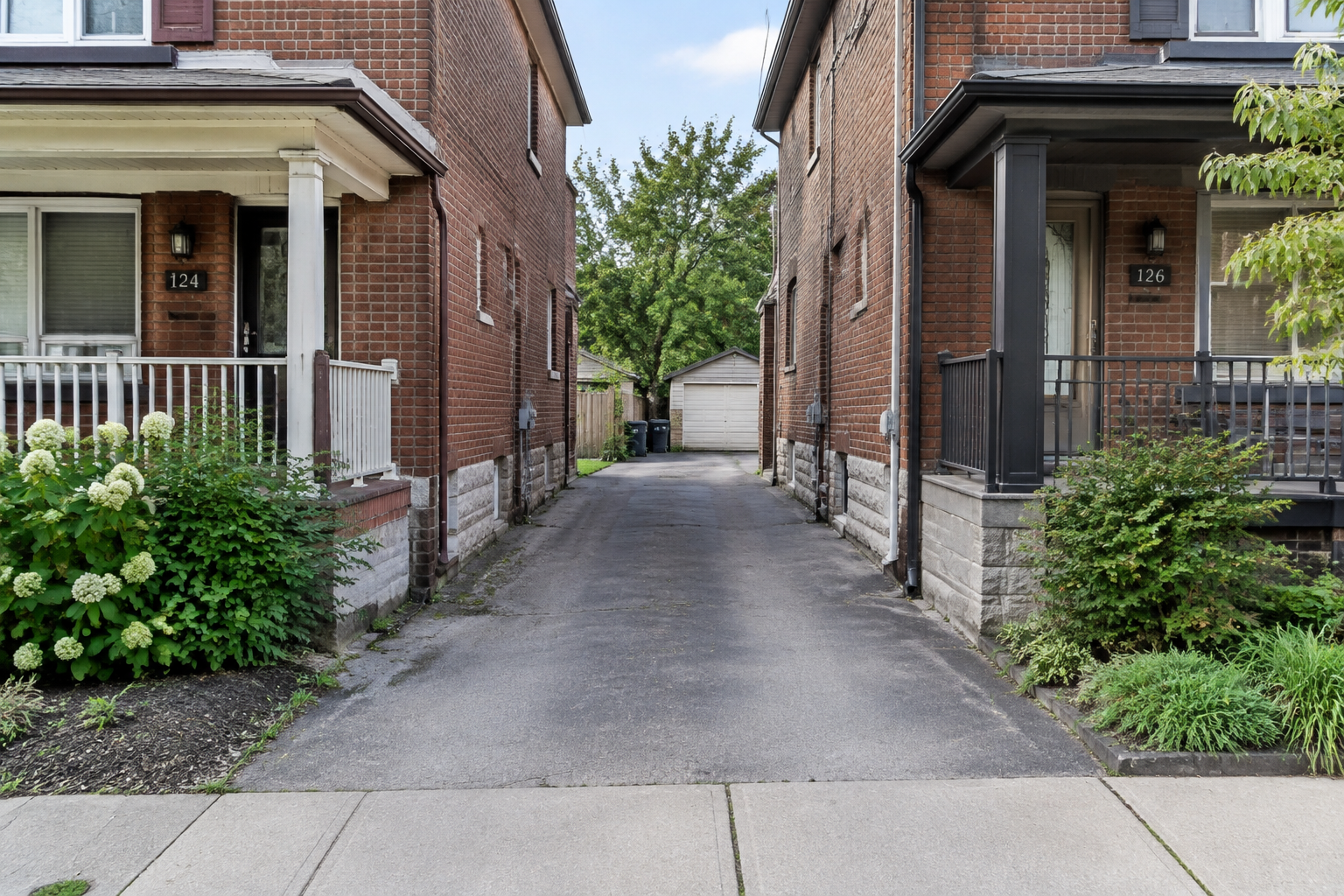
- Don't block it. A mutual driveway is for access. In a 2022 Toronto case (Fromstein v. Michele-King, 2022 ONSC 6602), the Ontario Superior Court ordered an owner to remove a fence and other obstructions from a mutual driveway, finding that blocking a mutual right of way breaches the neighbour's rights. She was also ordered to pay about $75,000 of her neighbours' legal costs.
- Measure it. Many mutual driveways were built for smaller cars, and some listings advertise a mutual drive that's too narrow to use comfortably. Measure it, and try it with your own car if you can.
- Read the documents. Your lawyer should review the right of way on title and any written agreement about maintenance and snow clearing. A current survey shows exactly where the property line and right of way are.
- Ask about the neighbours. Ask the seller whether there have been any disputes. Driveway disputes can be expensive and stressful, and they come with the house.
- A parking pad may still be possible. Where the by-law allows it, owners with a mutual driveway 2.2 metres wide or less at its narrowest point can apply for a pad beside the driveway (not on it). Neighbours on both sides can even apply together to share one curb cut.
Frequently asked questions
Can I park in front of my own house in Toronto?
On the street, yes, within the posted limits or with a permit if the street is a permit area. On your front yard, only if you have a front yard parking licence from the City.
How much is a parking permit in Toronto in 2026?
A residential permit is $24.23 a month plus HST for your first vehicle if you have no on-site parking. Visitor permits start at $20.74 plus HST for 24 hours.
How long can I park on a residential street without a permit?
Three hours, unless signs post a different limit.
Does a front yard parking licence transfer when a house is sold?
No. The new owner must apply to transfer the licence and pay a transfer fee of $165.56 plus HST, plus a $73.78 municipal charge.
Can my neighbour park on our shared driveway?
Generally, neither owner can block a mutual right of way, including by parking on it, unless the documents on title or a written agreement say otherwise. Check with a real estate lawyer about your specific driveway.
Thinking about buying a home where parking matters?
We check parking before our clients make an offer: permit availability, pad licences, mutual driveway documents and zoning. Book a discovery call and we'll help you find a home that works for you and your car.
This article is general information, not legal advice. By-laws and fees change, so confirm details with the City of Toronto or a real estate lawyer.
Sources
- City of Toronto, Residential on-street parking permits (2026 fees)
- City of Toronto, Temporary on-street parking permits
- City of Toronto, Residential front yard and boulevard parking (2026 fees)
- City of Toronto Municipal Code Chapter 918, Parking on Residential Front Yards and Boulevards
- Ontario, Get an accessible parking permit
- Mondaq, Neighbour ordered to remove obstructions on mutual driveway (Fromstein v. Michele-King, 2022 ONSC 6602)
Ready to start your search?
Book a free, no-obligation consultation. We'll talk through your goals and map out a strategy.
Book a free consultation